Norval Morrisseau’s Images Enchant Children

….it started as an art project with the kindergarteners

November was Aboriginal Month for our school board. I introduced my kindergarten class to Canadian First Nations artist Norval Morrisseau. He was sometimes referred to as the Picasso of the North. His art is characterized by the use of heavy black lines and bright vibrant colours.

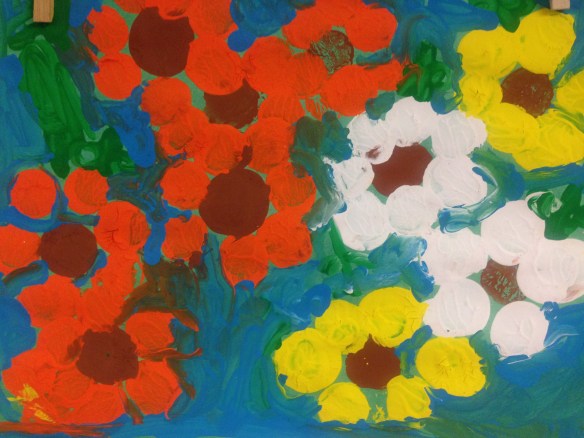
I found a couple of images on the web that were reproducible and I drew a couple more free hand. I gave the children some bright acrylic paints and cotton swabs  and  taught them how to create dots with the Q-tips. Some of the children used the tool like a paint brush and didn’t really get the concept of creating dots but in the end they all cooked very nice.

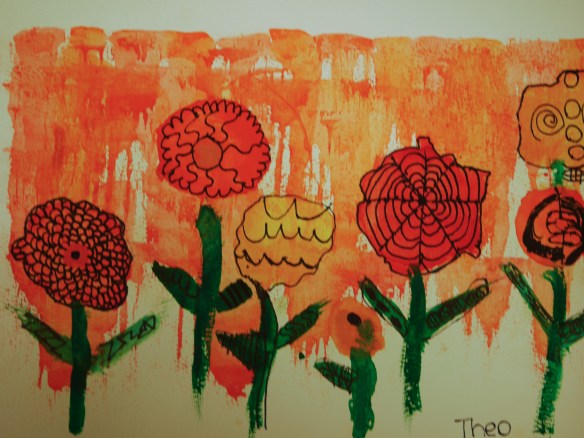
I used the same sheets with my grade three students but it was suppose to be an extra project for the students who finished their other art project before the end of the class. In the end they all wanted to fill in one of the four images.

The first set were done by the kindergarten class.


This set was done by the grade 3s.

Pinterest is a Teacher’s Best Friend

….for art lessons, teaching math, classroom rules, class management and Christmas crafts

Last week we hosted our annual Craft Night at our school. It’s an event that the community of parents and students loves to attend. For weeks in advance the teachers pair up with a colleague (some go solo) and scour the internet for craft ideas that small children and their parents can successfully complete in 10 to 15 minutes or less.

The parent council funds the evening and each teacher is given a set amount of money  to purchase supplies. It works out to approximately $1.00 per craft. This year some of the crafts included bees wax candles, decorating glass ornaments, making bath salts,  and decorating cookies.

I went straight to Pinterest for inspiration and came across these beautiful paper trees mounted on a disc of spruce wood. Lyckoslanten is a Finnish blogger who posted this simple craft over at Lyckoslanten. I didn’t discover the translation button till much later but I easily figured out how to recreate this craft.

The tricky part was figuring out how to get the wood. At first I thought I could pick up branches from camp but that didn’t happen. Then I thought I could use the cut-offs from Christmas trees but we didn’t get our tree until after Craft Night.

into intoA week before  the event I went to a Winter Market in the Junction. While there I saw a couple of vendors who used birch wood to create some of their crafts. I also saw some beautiful trees made from birch wood. I asked them where they got their wood. One of the vendors offered to cut all the discs for me but at a price of course and it would have used up most of my budget. In hindsight it might have been worth it. The other vendor suggested that I buy the birch logs from a garden centre and use a chop saw to cut them up. A much cheaper option.

I went with the cheaper option and spent two evening cutting up two twelve foot birch branches into about 180 discs. I couldn’t belief the amount of sawdust it created. I spent almost as much time cleaning up as I did cutting. After I cut the discs I also had to drill holes into each disc for the skewers to fit. My friend L photocopied Christmas sheet music onto 150 sheets of photocopy paper. We tried heavier card stock but it was more difficult to fold.

On the night of the event we set up the tables at the back of the library with all the supplies that people needed to complete the trees. We added some tiny gift boxes that could be added to the base and some stars and snowflakes that could be glued onto the paper.

The entire evening took only an hour but it was extremely busy and I spent most of my time punching holes into the pleated paper so that the skewers could go through the middle. By the way, the best tool for this turned out to be an awl and a hammer. All in all it was a very successful night and everyone loved their trees.

img_0747

Gathering Colours from Magazines and Old Books

….and then cutting them into squares, rectangles, circles and triangles to create buildings

The advantage of cutting out shapes from magazines or books is the added texture one gets. It is easier to just cut up construction paper but the act of looking for colour swatches in magazines teaches children and adults about the vast range of one colour (i.e., red can be cool (blue undertones) or warm (more yellow undertones), dark (with the addition of black) or light (by adding white) and vibrant or muted).

After a class of cutting and sorting colours we were ready to start cutting our shapes and layering  our pieces to create a collage of buildings. My grade threes were allowed to create a landscape of countryside buildings or a cityscape and they were encouraged to add foreground details and/or background details. The last step involved adding details with a black Sharpie and paint dots to make the whole piece come alive. The following are examples from one of my grade three classes.

img_0701img_0702img_0703img_0704img_0705img_0706img_0707img_0708img_0709img_0710

Rome’s Top Ten – Part 2

…..trying to cram all three days into one post proved too much

Vatican City

I won’t spend too much time here since I’ve already written about my experiences at Vatican City here. Next time I need to make time to see the Vatican Museum and the Sistine Chapel.

img_9660

Piazza Navona

Piazza Navona is one of the most popular public squares in Rome. It is built on the site of an ancient Roman stadium, Circus Agonalis, that could hold 20 000 spectators. Today it is best known for the three beautiful fountains that are situated along the centre of the Piazza. The fountains were designed and sculpted by Bernini and Giacomo della Porta.

Castel Sant’Angelo

Castel Sant’Angelo is a towering cylindrical building that was initially commissioned by the Roman Emperor Hadrian as a mausoleum for himself and his family. The building was later used by the popes as a fortress and castle, and is now a museum. The Castle was once the tallest building in Rome.

Over the years the popes converted the structure into a castle, beginning in the 14th century; Pope Nicholas III connected the castle to St Peter’s Basilica by a covered fortified corridor called the Passetto di Borgo. The Papal state also used Sant’Angelo as a prison.

In the next few days I’ll write about Trastevere, the Roman Forum and the National Monument of Victor Emmanuel II. Till then, Ciao!

Crazy Hair Art

….thanks to Mary from Be Creative Mary for this great art project

I wasn’t going to do this with all my classes but when the first finished pieces went up on display all of my students wanted to know when they were going to do the same project.

After the first group finished this project I realized that I had to put some restrictions on their enthusiasm. I had to remind students that this project was about the crazy hair coming out of the top of their heads and not what came out of their noses. Most of my art students are in grade 3 and a small handful are in grade 2 this year.

After taking their head shots I converted the photo into black and white and printed them on simple photocopy paper. I cut out all the photos and removed most of their hair. Seeing their reactions was priceless. I did have to stress that the hair they created needed some shape so that colour could be added to it. I didn’t want them to simply add a scribble over their heads.

Here are some of the finished pieces that have already found their way onto the bulletin boards in the hallway of our school.

These followed a few days later:

WPC – Quest: Vatican City

….while in Rome my quest was to get to Vatican City

There were many things that I wanted to see on our trip throughout central Italy but one that stood out for me was Vatican City. I’m not sure why it was so important to me because I am not particularly religious. Perhaps it had to do with the numerous suggestions that I got before flying out to Italy. Almost everyone said I had to see Vatican City. On our last day in Rome and the day before we were to leave I was bound and determined to see it.

My son and his new bride were in Rome the same time we were there and he very much wanted to spend time with his family before we departed. He was willing to do anything and go anywhere I wanted. Seeing that no one else was up to another site seeing day, it was just me who met up with my son.

I ventured onto the tram by myself and met B, before the tram crossed the river into the busy metropolis of Rome. We walked to our destination in the hot sun, stopping for a snack and then later for a light lunch just outside of Vatican City. As we approached the city I was impressed by the sheer size of it. We had already passed over the bridge leading up to the castle that protected the Pope from invaders during Napoleon’s reign.

As we got closer I could see the square in front of the Basilica. There were barriers to keep you from crossing the square and people were lined up along the perimeter. The one thing that bothered me were the hordes of vendors trying to sell tours and selfie sticks. I don’t know how many times I said no, politely at first, but then more abruptly and tersely. At one point my son said ‘Don’t talk to me!’ to one of the vendors and an argument pursued. Well actually the tour guide salesman started yelling at my son, telling him he was rude. My son simply walked away, a little shaken up by the reaction he got from the statement he made.

At one point I told my son I was happy just seeing the outside of the Basilica and the square and that I didn’t need to stand in line to go inside. B, however, insisted that I had to see the paintings and sculptures in the church. He convinced me, with the help of his wife, now on the phone, that I should go inside. He asked if I minded going in alone because he had already seen it and he hated standing line as much as his father does. I told him I’d be okay and he waited outside, under a portico out of the sun.

The line-up for a security check took only about 15 minutes and then I walked to the entrance in no time flat. As I entered I was told I had to cover up because I had bare arms. Luckily I brought a scarf with me for that very purpose. My quest to see Vatican City had been achieved.

Supercrawl in Hamilton, ON

….last weekend I went to my first art crawl

Since 2009, Hamilton has hosted an art supercrawl that now spreads over 16 city blocks and has gone from a one day event to an entire weekend. It celebrates the diverse art community in the James St. North community in Hamilton. This year it featured numerous art installations, hands on art demonstrations, live bands, street performers, dozens of food trucks, and hundreds of vendors selling jewellery, crafts, paintings, clothing, knitwear and handmade toys. Supercrawl 2016


Florence, Italy -An Art Lovers Paradise

…..Florence is well known for famous sculptures, paintings and architecture 

Everyone told me I’d love the art in Florence. There certainly was a lot of it. The city is noted for its culture, Renaissance art, architecture and monuments. The city also contains numerous museums and art galleries, such as the Uffizi Gallery and the Palazzo Pitti.

Florence was home to one of European history’s most important noble families, the Medici. In 1469, Lorenzo de Medici, grandson to Cosimo, took over control of the city from behind the scenes. He was a great patron of the arts, commissioning works by Michelangelo, Leonardo da Vinci and Botticelli. To his peers he was known as Lorenzo il Magnifico which ironically was also the name of the street our apartment was on.

If you are going to Florence in the near future I would recommend that you prebook your tickets to the Uffizi Gallery. We booked on line the night before and went right to the front of the line when we arrived at our designated time. In fact we were ushered to an even faster line because we had the baby with us. Even though the baby was free of charge they wanted to see her passport before they gave us our tickets. We didn’t have the passport so we pleaded ignorance. Who knew? Did they think we were going to smuggle in an adult on an infant’s ticket? Other than that, getting into the popular Uffizi was quick and relatively easy and well worth the few extra euros to book ahead of time.

We never did get to see the real Michelangelo’s David. The two in the gallery above were replicas. I thought I would be disappointed if I didn’t get to the real one but there was so much to see and do and it was so hot in Florence that it wasn’t worth the ultimate exhaustion we would have suffered trying to get to the Galleria dell’Accademia di Firenze, which is now the home of Michelangelo’s sculpture of David. Maybe I’ll go there the next time I’m in Florence.

Ciao!